

Pulley, the cap table platform, will cease all operations and services on December 8, 2026, and has arranged an assisted move to Carta for its customers. We had already moved our own cap table. We started Cap Table on October 22, 2026, released it as open source under the MIT License six days later, then spent two weeks moving to it and polishing it. It was a side project written largely with AI coding agents. It is free to use at captable.insulinapps.com, and the source is on GitHub.
AI agents can use everything in the app through MCP, the Model Context Protocol. We didn’t build an AI agent into the app. You connect the one you already use.
What does Pulley’s shutdown mean for its customers?
Pulley ceases all operations on December 8, 2026, and customers keep limited access to their data until January 31, 2027. Both dates are from Pulley’s shutdown FAQ, which describes an exclusive partnership with Carta. Customers sign a new agreement, and Pulley pricing is honored for the first full year. The FAQ says that, without a new agreement with Carta or another provider before December 8, customers lose access to their cap table.
Export your reports from Pulley while you can. Cap Table imports six of them as Excel files: Raw Cap Table, Detailed Cap Table, Stakeholders, Vesting Details, Exercised Options and ISO/NSO Details, plus Stakeholder Transactions if you have it. Export them from Pulley’s Reports page on the same day and leave their columns unchanged, so they all describe the same point in time.
Why could a side project replace it?
A private company’s cap-table record is small and well understood, and the difficult work is keeping it correct and controlled. Pulley’s notice and FAQ give no reason for the shutdown, and we don’t know the reason.
- The model is small. Stakeholders, share classes, equity plans, grants and their vesting, exercises, terminations and valuations. The rules are detailed, but they are written down and change slowly.
- The work was checking, not typing. AI coding agents produced the first version in one week. We spent the next two weeks proving it matched Pulley. Before saving anything, the import compares every total in Pulley’s reports with the total it computes.
- Sign-in and hosting were already solved. Accounts, single sign-on, roles and the MCP server come from the platform the app runs on, insulinapps.com. The app has no login code of its own.
- Agents can handle many questions that once needed a report screen. An agent can answer a question such as what vests next quarter by reading the app’s API directly.
We think a stand-alone subscription for the part of a cap table product we used is a harder sell when a team can rebuild that part in three weeks.
What does Cap Table do?
It keeps one company’s equity record: who owns what, how each holding came about, and how it vests, as of any date.
- The cap table as of any date. Issued and outstanding shares, fully diluted ownership, every share class and equity plan, and every holder’s position, computed from the full history for the date you pick.
- Setup by import. From Pulley’s standard reports or the app’s own spreadsheet template, with a plain-language preview before anything is saved.
- Option grants and vesting. ISO and NSO grants from a plan, with vesting schedules and exercise prices. The app works out vesting, what can be exercised and every deadline.
- Exercises and terminations. Record an exercise with its payment, fair market value and tax details, and the app creates the shares. Stop vesting when someone leaves, today or on a future date, and see what goes back to the pool and how long they have to exercise.
- 409A valuations. The app tracks when each one expires or needs review, and won’t price a new grant without a valid one, or counsel’s memo.
- Documents and reports. Agreements, board consents, certificates and valuation reports stay with the records they belong to. Download the cap table, stakeholders, vesting details, exercise history and the audit log.
- A holder view. Employees, advisors and investors see their own shares, options, vesting and the documents you share with them, never the cap table or anyone else’s holdings.
- Built-in docs that explain equity basics in plain words, with a glossary, for everyone who opens the app.
Share classes, plans and existing holdings arrive with the import. After that, the app records new grants, exercises, terminations and cancellations. There are no forms for adding share classes or issuing shares. It doesn’t support RSUs, SARs, phantom stock, convertible notes or profits interests.
How is it built?
Cap Table has two parts: a platform that decides who may do what, and an app that keeps the record.
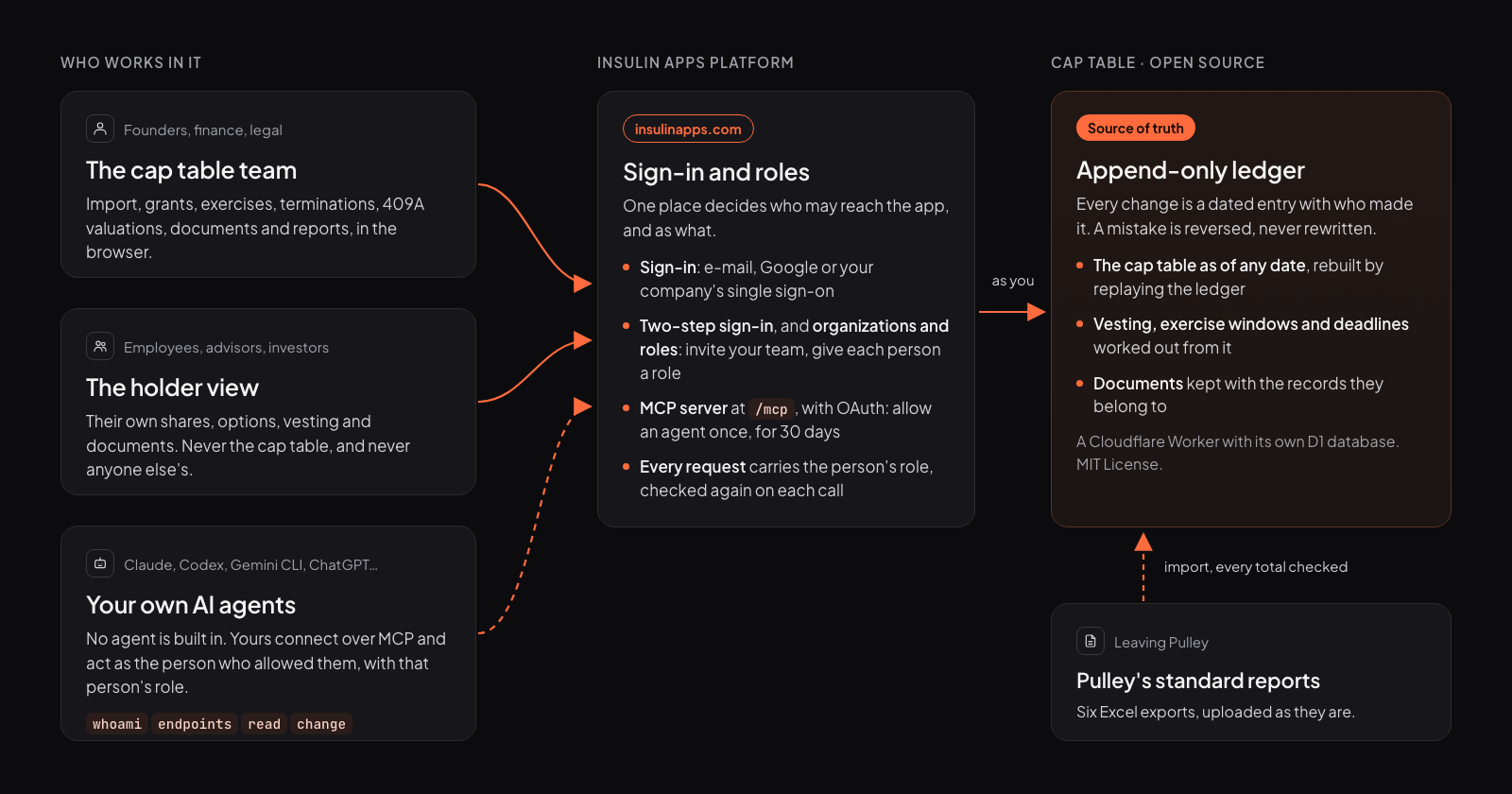
- insulinapps.com handles sign-in and access. E-mail, Google or your company’s single sign-on, two-step sign-in, organizations and roles, and OAuth for AI agents and API clients. It checks the person’s role before each request reaches the app, so the app has no passwords, sessions or login screens.
- The app is a Cloudflare Worker with its own D1 database. It has a React front end and a small API in one npm project.
- An append-only ledger is the source of truth. Every change is a dated entry recording who made it. Holdings, vesting, deadlines and the cap table are computed by replaying the ledger, so the cap table for a past date is exact. Errors are corrected with reversing entries; existing entries remain.
- The holder view is allowlisted. A holder’s requests go to separate handlers that read only that person’s records and return only approved fields, and tests check those responses field by field.
What does moving off Pulley look like?
Upload the reports, review the preview, and import in one step. The import sets up an empty company. Before anything is saved, the preview identifies each file, every problem that blocks the import with its file, sheet and row, the assumptions made where the reports leave something open, and a comparison of every total in Pulley’s reports with what the import will produce. Once nothing blocks it, Import creates the company and its ledger from the reports. From then on, Cap Table records each change.
How do AI agents work with it?
Every app on insulinapps.com is its own MCP server, and an agent you connect acts as you, with your role. For Claude Code, add it once:
claude mcp add --transport http captable https://captable.insulinapps.com/mcpCodex CLI, Gemini CLI, opencode, Claude.ai and ChatGPT connect the same way; the app’s Connect AI page has the setup for each. The first connection opens a consent page where you choose the organization and choose Allow, which lasts 30 days or until you disconnect the agent. The agent gets four tools:
| Tool | What it does |
|---|---|
whoami | Who the connection acts as: the person, the organization, the app, the role and the permissions |
endpoints | The app’s API, as far as your role may use it: each endpoint’s method, path, summary and schema |
read | A GET on a path under /api/ |
change | A POST, PUT, PATCH or DELETE under /api/, made as you |
An agent calls endpoints to learn the API, then reads and records what a person with your role could. Its changes land in the history like any other. Your role is checked again on every call, so lowering it also lowers the agent’s access. People, roles and integrations are managed in the browser only. For how this differs from a vendor integration, see MCP server or integration.
Why isn’t there a built-in agent? Because the one you already use is better placed than anything we could ship. It knows your other tools, your files and how you work, and it keeps improving without us. What the app owes it is a complete API, described well enough to use without help, behind the same permission checks a person gets.
What did leaving Pulley cost us?
A vendor’s support desk, an uptime commitment, and features we never used.
- No uptime guarantee. The hosted version is provided as is.
- No e-mail. The app doesn’t notify anyone when their holdings change; you tell them.
- No signatures or payments. Agreements are signed elsewhere and uploaded; payments happen outside the app and are recorded in it.
- No valuation, tax or legal service. The app records 409A valuations but doesn’t perform them, and it files nothing.
- Fixes are ours. When something is wrong, we change the code. With the source under the MIT License, anyone can do the same.
We made the same trade for tickets, for similar reasons: how we replaced ClickUp with GitHub Issues.
Where does Insulin come in?
Cap Table is one of the open-source apps at insulinapps.com, and it follows the same app layout as the apps Insulin Apps builds from a description. It is a real app with its own backend and database. If your team needs a business app of its own, you can describe it there without adding another subscription.
Keep reading
Stay Updated
New posts, product updates and marketplace strategy are shared on LinkedIn as they publish.
Follow Fours on LinkedIn